Showing posts with label Imperial. Show all posts

Saturday, 21 March 2026

Vexillator Space Marines


The Vexillators are thought to be an Imperial Fist successor chapter, whose creation is usually attributed to the 23rd Founding (the Sentinel Founding) during the 37th Millennium. It was a major expansion of Space Marine Chapters in a concerted effort to shore up the Imperium's military strength, after a series of catastrophic losses in the preceding centuries.

The Vexillators were to be tasked with establishing a perimeter of Chapter-Keeps around the Acheron Subsector and the strategically important Medean Warp Cluster. They were meant to be principled standard bearers of Imperial doctrine, bringing protection and, to some degree, governance to a system that needed both.

But during their initial deployment, upon exiting The Warp, it is said they were caught in an unexpected blockade, possibly by a roving Ork Rok Fleet, which saw them embroiled in a bitter space war before ever being able to establish reliable supply lines and Recruitment-Chapels.

Without resupply or any kind of foothold in their new system, they soon found themselves depleted to such a degree there was little chance they would be able to fulfil their mission in the manner it was expected. So out went steadfastness and tradition, and in came spontaneity and improvisation. Guerrilla tactics favouring lightning raids and rapid withdrawals took the place of more honourable confrontations. Hitting the enemy fast and hard, became their norm. They gradually morphed from a rigidly disciplined chapter, focussed on siege mastery and defence to a more motley force, embracing speed and agility.

Over time these new strategies showed a level of success and the Vexillators were able to establish some ground and replenish their strength. By then many of the new ways had taken root, and they found they were less like their their proud legionnairy forebears and more like pugnacious brawlers. What they lost in righteous superiority, they gained in agile survivability.

In fact, having ward over an entire Subsector of previously embattled planets, started to give the reforged Space Marine Chapter a steady influx of resilient aspirants. It wasn't long before they were able to re-ignite some of the old ways, and even, 
in the late 38th Millennium, form their own Successor Chapter, the Storm Guard.

This younger chapter was left to fulfil the original role of shoring up the Subsector, while the Vexillators, as self-inflicted retribution for their earlier failure, headed off into deeper space on a crusade to bring the Emperor’s light to the darkness. Liberating and reclaiming lost worlds as they pushed through to long-forgotten systems.

But with the arrival of the Cicatrix Maledictum, and the opening of new rifts in The Warp, contact with the Storm Guard was completely severed, and the Vexillators made the decision to return to the Subsector they had, for a time, called home.


When the boxset Dark Imperium was released in 2017, heralding the beginning of 8th Edition Warhammer 40,000 (WH40K), it also ushered in a brand new range of Space Marines: the slightly larger Primaris. These taller miniatures had been redesigned to more accurately reflect WH40K lore, where Marines are meant to be post-human giants.

The average Space Marine is a genetically engineered behemoth, at least 7ft tall, built like a rhino, with a sub-dermal armoured carapace fused to his rib cage, an even stronger suit of armour worn for battle, dedicated to the art of war, carrying some of the most powerful hand-held weapons known to the Imperium of Man, and encouraged to be the toughest he could possibly be, by pretty much anyone he sees on a daily basis. The lowliest Marine would probably crush the toughest regular human in almost any kind of stand up fight.

So with the new, bigger, plastic toy soldiers, which had gone some way to redressing the inconsistencies with the old range and the lore, I decided to create a brand new force. These were not just to be a bit taller than my previous army, but also more rugged looking, battle-hardened and unique. I wanted a force where every single warrior looked capable of titanic achievement. And, although I loved the new Primaris design, I also loved some of the older marks of (now short-looking) armoured warriors that Forge World had been releasing in the preceding years. So I wanted my band of ragtag Vexillators to wear mixed armour marks, to carry dirt and damage, and to look like individuality was encouraged within their ranks.

To achieve this, my plan was to mix and match parts from the various different sized models, using thin plasticard spacers, inserted into legs and waists to make the shorter warriors look taller. To use different heads and helmets, and a variety of boltguns. To paint their markings in subtly different ways, and to generally treat each and every one of them more like a character.

This is my test model, and I hope to have several more following in his violently rendered wake by the end of the year.


Tuesday, 24 February 2026

Boarding action

Before I gave away the two little copses that I mentioned at the end of my previous post, I took a couple of photos of them in-situ on one of the other projects that I managed to get started last year. This is something fairly vital to achieving that truly satisfying feel of a fully immersive, narrative, tabletop wargame.

It's the tabletop itself. Or, more accurately, the board or boards that sit on the tabletop.

Rather than having bespoke builds for every setting, I always favoured the idea of a more modular approach. A bunch of boards that can connect to each other in a few different combinations, spanning a selection of terrain types that can be mixed and matched to create a variety of different locations. And then additional structures that can be added to further change the detail and complexity of the warzone. Ideally, simply by adding or removing items, I would be able to switch between a wide open battlefield suitable for Warhammer Fantasy Battle (WFB), Age of Sigmar (AoS) or Warhammer 40,000 (WH40K), and a dense, multi-layered environment more in keeping with Kill Team, Necromunda, Mordheim or Warcry.

Of course, the more you want to cover, the more you need to build. But by keeping elements as modular as possible, you can start to reduce just how much stuff you need.

Some terrain types made with a fantasy setting in mind might be compatible with a sci-fi set-up. A grassy Ghyran battlefield for AoS could double as farmland on an agri-world in WH40K.  And it could work in reverse too. With a little forethought some Mechanicus terrain elements for WH40K could be seen as steam punk style buildings in a fortified City of Sigmar, or a Kharadron Sky-Port or even a Skaven tunnel system.

I'm not really at a stage to test out these possibilities yet, but I'll keep it in mind as the project progresses.

My initial plan was to create a set of 2 foot by 3 foot boards, that had road points in the middle of each side. Some of the boards would be sci-fi, some would be fantasy, and some might blur the lines a bit. I figured grass, rock or dirt boards should almost definitely fall into that last category. 4 boards would be enough for a standard game of WFB or WH40K, but the more I make the more options I'll have.

With hindsight, I probably should have made each board 2 foot square, rather than these slightly larger rectangles. This would have dramatically increased the scope and flexibility of the final set by meaning boards could be turned 90 degrees to fit together. I'm a little annoyed I didn't work that out sooner, but I've already discarded my first attempt at this project, so I really don't want to start again once more.

With WH40K in mind I also decided I wanted to be able to stack buildings to create different densities. I put together a diagram of how I see them slotting into the base. 

I tried to work out if this system could be applied to a fantasy castle or town as well, but decided it would probably impose too many limitations. In fact it might even stifle the sci-fi terrain too, so I'll just have to see how this plays out.

The two boards that I had to discard were made on thin MDF sheets, about 6mm deep. Once finished and covered in glue and paint they started to warp terribly. So for this reboot of the project I started with 18mm MDF. It's heavy, but its also sturdy, meaning it won't bend out of shape so easily, and is less likely to jolt when knocked mid-game. 

The other benefit of the thicker MDF is that I can carve into it to create depressions. This means a 3D feel can be achieved, while keeping the surface flat to accept buildings and other smaller terrain pieces wherever necessary.


The design of the road varies slightly on the countryside board, so that it can be used with both fantasy and sci-fi settings. I also added a slightly raised area in order to play with line of sight a bit.


This is just the very beginning of the project, but I'm pleased with the finish of these boards, and am really looking forward to having a larger set of them. Although, as ever, I'm not really loving the idea of finding the time needed to create them.


Wednesday, 6 August 2025

The ute of today

I love this hobby. I really do. It's safe to say that I've dedicated quite a chunk of my life to constructing and painting 28-32mm scale miniatures based on the various worlds of Games Workshop. Anything can spark the beginning of a project: the release of a new miniature; something I saw online; a passage in a book; a scene in a movie; or even a real-life object, building or landscape. I never really know where the inspiration will come from, but it usually forms the burning need to create some cool-looking derivative model that will somehow slot into my existing collection. Often I'll start with the intention of really going to town, taking my time to actualise the ideas floating around in my head in a way that is as accurate or interesting as possible. To attempt to achieve something that sits at the (admittedly not very high) pinnacle of my capability. 

But occasionally I'll simply want to paint a model with the sole intention of clearing some desk space.

This Mantic Mule was just such an occasion. Released as a robust, sci-fi, military asset, I thought it would instead make a rugged, little, utility vehicle (or ute) for more domestic usage. The sort of thing you might see driving around the enclosed road system of an Imperial Hive City like Kruenta Karoliina Arx Rotunda.

But once I'd built the thing, it just sat there for years, looking forlorn and unloved, collecting dust. It's not alone in that fate, as I have hundreds of unpainted miniatures waiting for their moment under the brush. But when I absent-mindedly picked it up earlier this week and reacquainted myself with its muscular design, I realised that if I stuck to a quick, simple, paint-job, I could get the whole thing completed using just the spare moments of that single day. 

So a lunch-break and a bit, a decidedly non-military colour scheme*, and a handful of dry transfers (that I'd never used before, but which I wanted to include as an oblique reference to my rugged, little, youngest son) and this was ready for display.


As is often the case with these quicker projects, I'm a little indifferent to the final piece. I'm neither proud of it, nor do I dislike it. It's good enough to add to my collection of domestic 40K models, without being any kind of centrepiece.

But at least I have a little desk space back.


*Non-military colour scheme in the classic sense, that is. I guess there are plenty of sci-fi forces that use colour schemes heavily featuring yellow and green. My very own Ork Armoured Brigade being a pretty good example.

Sunday, 26 January 2025

Three fast cars

In the classic 60s heist caper, The Italian Job, a British criminal crew put together a collection of vehicles with which to steal a cache of gold and drive it across the Alps. As well as the iconic 3 Mini Coopers, they also get hold of an Aston Martin DB4* and two Jaguar E-Types. These three fast cars, as Michael Caine's Charlie Croker explains, were on standby in case anything goes wrong. They were to be used as emergency escape vehicles, presumably for rapid redeployment of the senior gang members, should things go belly-up.

This idea of having fast back-up vehicles in case of trouble is not entirely dissimilar to something my dad once told me about motorcycling. If you're going to ride around on a bike, at some point you're going to get into trouble. So try to make sure the bike is quick enough to get you out of that trouble, before hospital or the morgue catch up with you. Of course it's not flawless logic, but in my time as a biker it definitely came into play on at least one occasion.**

Civilian motorbikes should play out in a future project, but for now the idea of quick, nimble transport, that isn't military in its design, is going to concern itself with vehicles of the four-wheeled nature. It's something I've wanted to bring to my Warhammer 40,000 tabletop wargaming collection for a while, as it fits well with my interest in the domestic side of life in Games Workshop's far future. Of course, in the game, we rarely get to see this civilian side, and the setting only occasionally reveals the existence of what it refers to as groundcars. There are scattered mentions in some Black Library fiction, but the only official models I can think of that come close to being actual cars are the Achilles Ridgerunner for the Genestealer Cult armies and the Tauros and Tauros Venators from the Enforcer and Astra Militarum ranges. And to be fair even these are substantially more like military buggies than civilian cars.

Achilles Ridgerunner and the old Elysian Drop Trooper Tauros

So what might civilian groundcars actually look like? The first time I saw any kind of model to represent this was probably way back in April 1990, in White Dwarf issue 124. In the 'Eavy Metal section we were shown Dale Hurst's scratch-built Genestealer Cult Coven Limousines.

Dale Hurst's seminal Genestealer Cult

This sparked a wave of similar-looking converted vehicles, that used contemporary cars from other toy companies as their basis. Eventually smaller wargaming companies got in on the act, and some truly incredible models were produced. Most notably for me was the line of civilian vehicles made by Grim Skull, for use not just by the aforementioned Genestealer Cultists, but by Inquisitorial warbands as well. At the time of writing, these models can still be purchased over at Wargame Exclusive. I might well take another look myself at some point in the not-too-distant-future.

Gothic sci-fi vehicles from Wargame Exclusive

The models include a wealth of incredible detail, from armour plates, to hood-mounted weaponry, caterpillar tracks, vents, spikes and even wings. But they were not quite what I was after for this project. I wanted something a little less ornate. Something that looked fast and utilitarian.

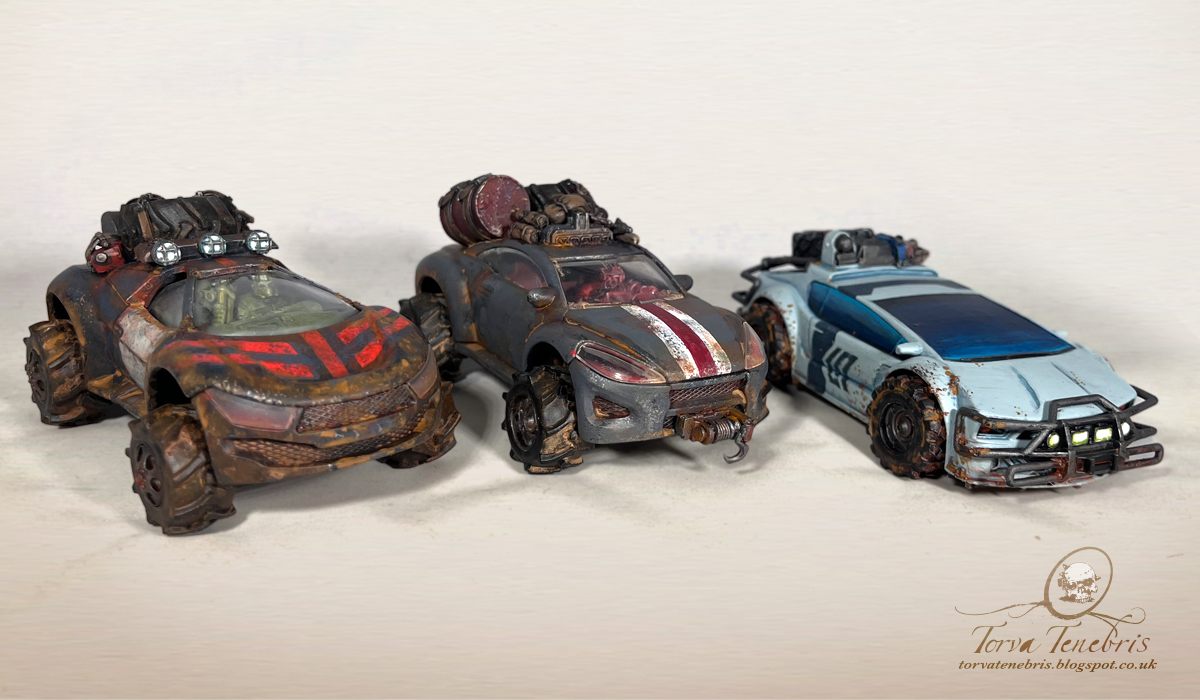
When I first heard Necromunda was taking to the Ash Wastes, I thought it was going to be a vehicular combat game, along the lines of Games Workshop's much earlier Dark Future. I had already made a handful of civilian vehicles (for use as both generic working sci-fi vehicles and as burnt-out terrain), so I was inspired to finish another small batch. But most of these earlier projects were about getting something finished, or exploring a paint scheme, rather than pursuing a specific design idea. So this time I wanted to go a bit further, taking The Italian Job's three fast cars as a starting point, and seeing what they might look like, ripping across the wastelands of the far future.

Enter the somewhat niche concept of customised, off-road sports cars. 


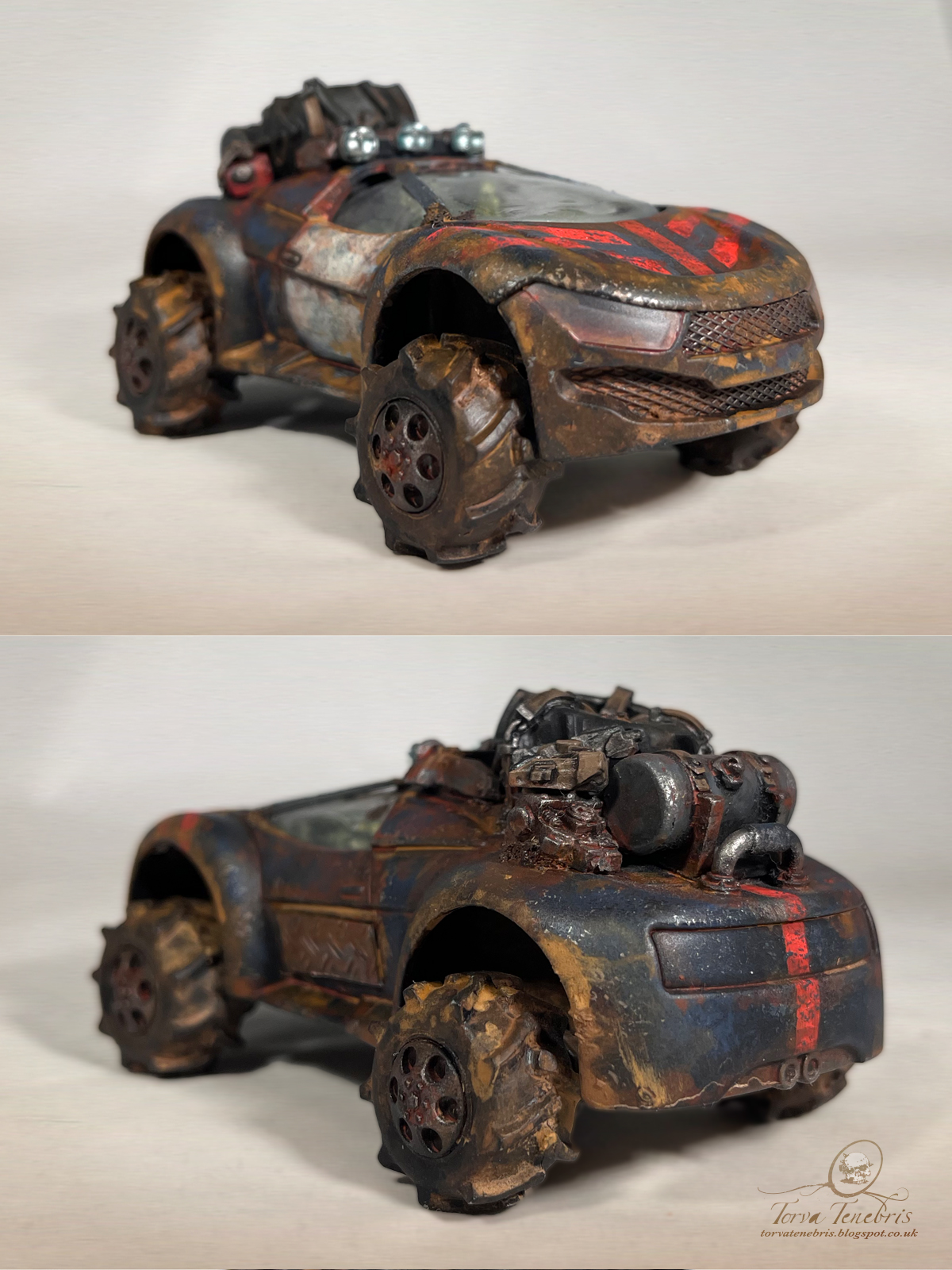
This was pretty much what I was after. But maybe not quite so pristine. So for the general condition of the vehicles I looked to the 2008 movie Death Race (the Jason Statham remake of Death Race 2000). The cars in the movie sported cool-looking guns, which were very tempting to appropriate on my models. But I had promised myself that my three vehicles would remain civilian to look at, being used for the deployment of gunmen, gangers and heavies, rather than carrying obvious mounted weaponry. Thus the cars themselves needed to be unarmed. So from the Death Race aesthetic I just wanted to incorporate some of the scratched and damaged panels, and hastily welded field repairs to give my vehicles a bit of much needed dark future flavour.

I was lucky enough to already have an unfinished model car in my collection that seemed like it might fit my desired look. It was the Marua Nemesis from the sadly now defunct Antenociti's Workshop. It's the black undercoated model in the below photo, and you can see my initial clean up of it here, from way back in 2016. After some scouting around in my local pound shops I managed to find another couple of fast cars that looked like they might be roughly the same scale. The red one is plastic, whereas the orange one has a metal shell. 


I broke all three models down to their constituent parts, in order to see what could be done without cutting anything up. 


Th
en ordered some additional bits from the ever-reliable Zinge Industries. Mainly wheels and lights.


After this, a quick raid of my bits box, including scouring through any left-over parts from Ramshackle Games, in order to find some extra gubbins to stick on the roof of each model.


And then just one last thing before painting. The two pound shop cars both had see-through windows and interior detail, meaning I was able to create a few armed gangers sitting inside, either driving the cars, or riding shotgun. This really helped, er, 'drive home' the message about ferrying manpower from one place to the next. If you look closely at some of these photos you can just see them through the plastic windows. 


After painting the first two in something approaching the Death Race style, I decided I wanted a lighter, more obviously different colour scheme for the third vehicle. So instead I went for a slightly newer finish, that, although clearly dirty, was only just beginning to take more serious damage. I should probably have used an airbrush to achieve smooth colour transitions between the lighter and darker areas, but to be honest I think I'm still a bit apprehensive of that particular tool. Perhaps more effort with an airbrush can be one of my goals for the year. I guess I can check back in December to see if it has transpired.


In the meantime I foresee quite a few more Orks on the immediate horizon, as I'm hoping to put a significant dent in the remainder of their un-painted army this year. But I'm getting ahead of myself. There'll be more on them and their machinery next time. Until then.


* Apparently the Aston Martin was damaged early on in filming, so a Lancia Flaminia was disguised to look like it for the Mafia hilltop scene where all three cars are pushed off the cliff.
** For the sake of balance, it's also worth noting that the sheer instant power of a sport bike probably got me into trouble as well.

Wednesday, 24 January 2024

Agents of the Imperium, shoulder to shoulder, side by side

I'm doing something a little different today. I wanted to try out an idea, so for this single exercise I've briefly changed my approach to the hobby. But before I get into that, a bit of backstory.

In late 1998, Forge World was unleashed on the world as a specialist offshoot of Games Workshop aimed at older, more experienced hobbyists. Although it was meant to concentrate on large scale busts and terrain, by the early 2000s it had dramatically expanded its scope to include an incredible selection of 28mm resin models.


There were so many amazing sets available, from just about every variation of Imperial Guard tank you could imagine, to mobile Ork fortresses on caterpillar tracks, huge Chaos War Mammoths, Death Korps of Krieg troops mounted on gas-mask-wearing horses, servitors, Inquisitors, dragons, aircraft and a hundred other models that I really wish I'd bought.

Forge World's Krieg Death Riders and Ork Battle Fortress. The latter is sadly out of print these days.
And the Chaos War Mammoth and Marauder Bomber. The elephant might be one of the rarest kits in existence.

In that last category 'models I wish I'd bought' were the Titan Crew On Foot, consisting of a Princeps and two Moderati, sculpted by Simon Egan. When they were first released they cost something like £12. My younger, naive self didn't know what was to come with the prices of models, and I think I found them too expensive. Yet they stayed in the range for about another decade, slowly creeping up in price to around £17, before eventually being consigned to the big-glass-display-cabinet-in-the-sky in the mid-to-late 2010s.

As soon as they disappeared from the Forge World website, I realised how much I wanted them in my collection. More so than any of the other fantastic models that were still available. A feeling I'm sure many other hobbyists out there are frustratingly familiar with. So I then spent several years scouring eBay trying to find them, in the hope of not having to pay the £70 to £100 they were routinely going for.

Finally, about a year ago, I found them for not much more than their original store price. Result! The downside was that as well as having been painted in colours not to my taste, they had also been converted slightly. But these were minor gripes, and it was still an opportunity too good to miss. So I bought them, dipped them in Dettol until the paint came off, then stripped away all the extra parts that had been added. To my relief the base models were almost 100% intact.

Last week I thought it would be an interesting project to get some paint back on them. I realised that the original Forge World paint job was pretty much exactly what I was after, so that got me thinking about the aforementioned experiment. I decided to break out my smallest brush and do my absolute very best to emulate the display colour scheme of the finished Forge World models as closely as I could. Obviously having the small brush wasn't enough in its own right, and unfortunately my lack of any real painting talent soon came into play.

Nonetheless I've posted the results here for all to see. Below are the original models, expertly painted by Stuart Witter for the catalogue, and then after that, my somewhat less expert attempt to copy the colour scheme and photograph them from the same angle.


Once I got started I soon realised that these characters sported some serious detail. So much so that I actually couldn't see it, even wearing my strongest reading glasses. For the first time in my hobby career I tried using a magnifying glass, but that made it extraordinarily difficult to coordinate the brush, so instead I came up with a rather foolish looking solution. I wore two pairs of glasses at the same time – and it revealed a whole wealth of detail that I had no idea was even there. Below are some more shots of Stuart Witter's beautiful smooth paintjob, followed immediately by my not-so-smooth effort.


Although this has confirmed my suspicions that I'll never be a superstar painter, I have actually surpassed my meagre expectations and am secretly quite pleased with the results. These guys will be a proud addition to my collection, going in among the various denizens of my hive city, Kruenta Karoliina Arx Rotunda.

So now I just need a Titan to go with them.

RIP Forge World of old, you will be sorely missed.


Thursday, 3 March 2022

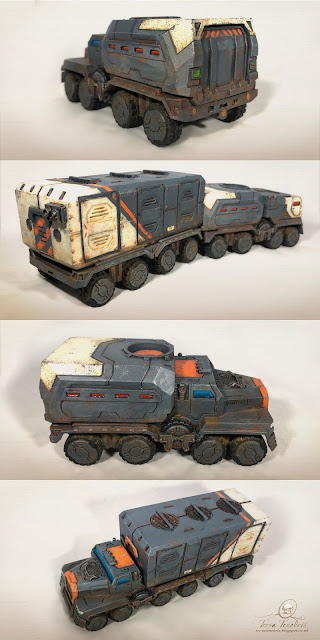
Necromunda Ash Wastes inter-spire light haulage rig and escort runner


In anticipation of the release of the new Necromunda Ash Wastes vehicular combat game, I've dug out a handful of unfinished models and given them a coat of paint.

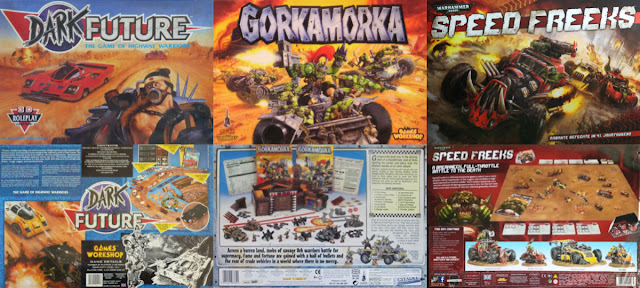
At the time of writing there's some speculation about the forthcoming game, but not many hard facts. As far as I can tell it looks set to introduce something like the Road Warrior aesthetic of the Mad Max films into the Warhammer 40,000 universe. And not for the first time either. Games Workshop has gone down this route before. Previous instances of the company riffing on George Miller's post-apocalyptic Australian action film series have produced the games Dark Future, Gorkamorka and Speed Freeks.

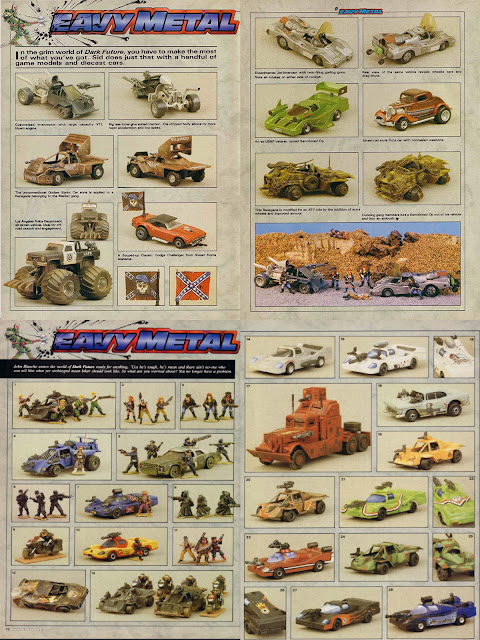
These three games all have various crossover points with what I imagine the new Necromunda expansion to be, but Dark Future, released in the late 80s, was the only one that focussed on human gangs – even if the models were in a slightly different scale to everything else. Coming in at roughly 20mm tall, the miniatures were way bigger than 6mm Epic scale, yet smaller than the 28-32mm of most of GW's other games.* But that didn't stop them being brilliant. Here are a few pages from White Dwarf around the time.

The game bonded a kind of sports car, go-faster aesthetic with the darker Mad Max look and feel, and the results ended up being occasionally grimdark, and occasionally colourful, and occasionally somehow both.

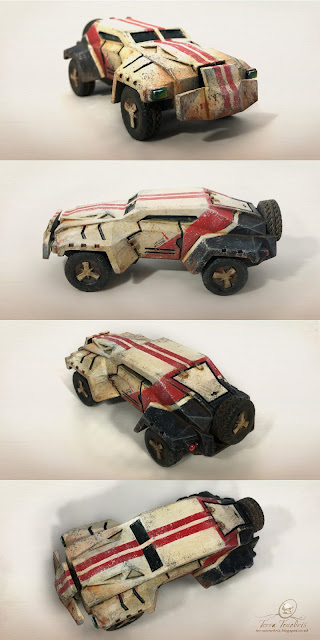
This started me thinking about what I call the Star Wars paint-job. It's the colour schemes we find throughout the Star Wars franchise, where vehicles are painted in predominantly flat, neutral colour tones: greys, creams etc, with a single, brighter, accent colour injected for detailing. And then the whole thing is beaten up, battered, and generally made to look as if it's seen better days. Luke's X-Wing in the original movie is a classic example, and it felt like an interesting direction in which to take a couple of ground vehicles.

The car below is a Marrua Gaucho from Antenociti's Workshop. It's a solid chunk of resin, and I've talked about the pre-paint clean-up here. I've decided this is going to be an escort runner; a fast set of wheels used to accompany a slower moving vehicle, providing extra tactical options, and additional manpower.


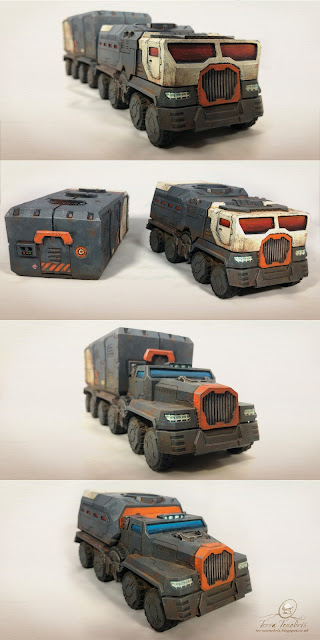
Meanwhile, I've called the truck an inter-spire light haulage rig – mainly because I'm anticipating the land train in the forthcoming Ash Wastes boxset to do a similar job, but to be significantly heavier. The model is actually a Pegasus Tactical Vehicle from Puppets War. You used to be able to buy the trailer (seen in the top image of the below set) that afforded a few different ways to construct the whole thing. I wanted to keep this modular capability as open as possible, so I talked about magnetising the various parts in an earlier post, here.
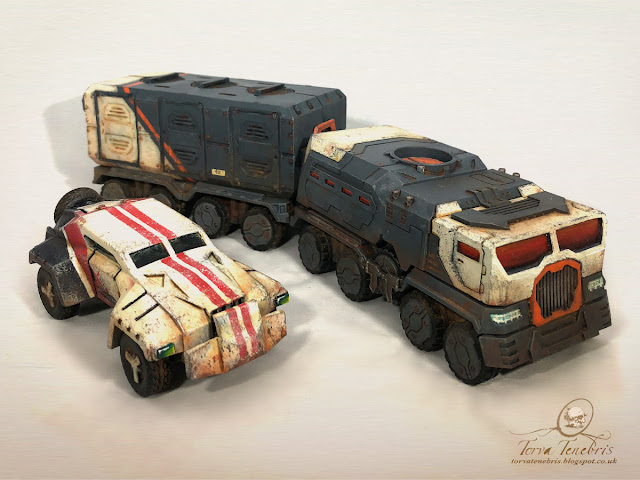
Below are some of the various different possibilities from the kit, seen from a few different angles. It was important to me that the two alternate cabs had individual paint schemes, but that the rest of the parts would be completely compatible with both.


And last, and probably least, I also quickly painted up the following little fella. It was kind of a test model for the other two, where I could brush up on the techniques and see what worked. The model itself was just a cheap toy car that I found in a pound shop a few years ago, and thought might be good for just this purpose. I don't love the paint job or the vehicle, but it's good enough to pass as a bit of background texture, tucked away in a dark corner, out of full sight.


So now all that remains is to await the new game and see if these models fit with its as yet unseen contents. That and paint the other 6 or 7 hundred other miniatures I've already got kicking around at home.


*And, of course, a lot smaller than the 54mm of Inquisitor. 
Tuesday, 18 January 2022

Pack it up, pack it in

Let me begin.
I'm currently facing an issue with the amount of stuff my family owns, versus the limited space in which we have to keep it all. There's a slowly rising tide of belongings that never quite fits anywhere and ends up leaving our home looking cluttered and untidy. I expect this might sound familiar to a fair few others out there.

I wonder if this problem still persists in the 41st millennium: Space Marines with more marks of armour than fit in their cupboard, Aeldari Rangers with helmets that are too tall for the shelf, Catachan Jungle Fighters with nowhere to keep their spare headbands.

If only there was somewhere to tuck all this surplus gear away.

Fortunately, if there's one thing that almost always improves a good sci-fi setting, it's crates. Crates in all shapes and sizes. Crates in a variety of exciting paint schemes, left lying around in any empty space that's in need of some extra detail. 

You see them in all sorts of science fiction media: movies, shows, comics and especially video games. Sometimes they are there for good reason, and sometimes they are merely set dressing. And Warhammer 40,000 is no different. Adding crates, containers, boxes and cylinders to the game's terrain can look so good I often have to consciously stop myself from randomly gluing them down all over the place. Little clusters of storage material, firmly fixed to some narrow gantry, completely blocking any access for actual miniatures, rendering the piece fairly useless in game terms, but really making it look the part. 

Really making it look the part, provided, of course, you can suspend disbelief for a moment and not question why something was neatly packed away, only to be left lying around in a completely inappropriate location.

Anyway, here are a couple of pieces I've just finished painting, ranging from big (completing the set I started back here) to small (using parts from a variety of sources, including Mantic Games, Citadel, and even some glued together bits from a broken one of these.)


They'll be joining the other pieces of scatter terrain, already in my collection, some of which can be seen below.


So now that I've stopped and thought about this, next time I see something similar, pushed into a spare corner of whatever science fiction story I'm looking at, I'll be asking myself what I think is actually in these crates, and, if it was worth packing up, why isn't someone stealing it?


Tuesday, 16 November 2021

Fast forward 12 months

It's been almost exactly a year since my last post. That's a huge gap, but the good news (at least for me) is that, although this blog has been dormant, my hobby activity has not, and I have plenty of bits and pieces to share over the next few posts.

But firstly, let's start with why. Why have I been quiet for so long? Well, the main reason is that this time last year, my wife and I began to undertake some fairly extensive work on our family home. Work that saw us completely pack away all my models, tools and paint, that saw us remove most of the top section of our house, that saw at least one ceiling fall in, and two people fall through them (neither were injured), that had rain water pouring down internal walls, a bedroom completely open to the elements for several days, and that ended up taking more than twice as long as originally estimated. But after everything was over, and finally complete, work that gave us a whole new floor on our house. I'm talking, of course, about a loft conversion, but after the painful, drawn-out process that we went through, it feels like so much more than just those simple words.

When we first started the work, I had no idea that I'd be putting this blog into such a long slumber, even though the building work had been planned many months in advance. I just never put two and two together and realised quite how disruptive it would be. I hadn't accounted for some of the intense mental anguish that would occur, while watching one's home being quite literally torn apart.

But it's done now and the upshot of the process, as far as this blog is concerned, is that instead of a dingy space, in among the rafters of a dusty roof, I now have a properly appointed office for all my work and hobby pursuits.


When fitting out the room we ensured there was plenty of shelf, desk and storage space. Me so that I could fit everything in and it would still be neat and functional, and my wife so that she could guarantee there wouldn't be any of my toys elsewhere in the house.

One of the biggest boons of this, and of being forced to organise everything from scratch, is that when placing finished models on shelves, I was able to set them up as little displays – almost like dioramas. 

Chaos troops man the ramparts of a town they have taken...
... in defence against the approaching Undead horde
Dredd style Arbites Enforcers bring riot suppression weaponry to bear
An Ork armoured brigade starts to amass in preparation for their next Waaagh.
The streets of Kruenta are alive with all manner of Imperial citizenry

There was a lot more to the last 12 months than just the moments I've touched on above, and there's a fair bit more to my office than just these images, but I think it's probably best to leave it here for now, to ward against the dreaded approach of boring and excruciating detail.

What's that? Too late?