Showing posts with label Terrain. Show all posts

Monday, 4 May 2026

The hobby... but better: LoreKeeper.com

A couple of months ago I was lucky enough to visit Warhammer World with my brother and his friend Dave.* The trip was ace, and I strongly urge anyone interested in tabletop wargames or collecting miniatures to make the pilgrimage to see it for themselves. But even surrounded by some of the greatest dioramas on Earth, in the very beating heart of the Games Workshop hobby, one of the biggest revelations for me came directly from Dave.

Dave is a major hobbyist, just like me, but his obsessions lie in slightly different areas. Where my primary focus is on collecting and amassing toy soldiers, Dave's is much more about the actual gameplay. And not just miniature-based games. I think it's fair to say he is fascinated by the way games work. By the mechanics behind the gameplay and the total immersion into the world they create. And being of not dissimilar age, Dave has had several decades to master his passion. He's an expert in almost every area of the hobby, and as such focusses a lot of his talent on being a Game Master (or Dungeon Master) so that others can enjoy the hobby too.

This focus on having others enjoy the hobby has formed the basis of an incredible project that was the aforementioned revelation for me. With the aid of AI tools, Dave has created a website that puts an immense amount of creative power into the hands of would be gamers.

LoreKeeper.com is a site designed to bring narrative gaming ideas to life. A site that can help you build worlds, create characters, invent plotlines and objectives, and visualise them in ways I thought were simply not possible. It puts an incredible level of ability in the hands of anyone who uses it.

In its own words: 'From zero to a fully-fleshed world in five steps. Upload your notes, chat with your AI Game Master, generate content, and export a professional worldbook.'

There are many levels to what LoreKeeper can do and the depths it can master, but on the surface, the one which immediately caught my attention was its ability to make short animated scenes based simply on notes or photographs. Dave fed it a still image of these three Deff Dreads, against a white background, and soon after we were looking at the below video.

I had a play around with it, and without any training whatsoever, was able to come up with the below (based on these guys and this board) in a few short minutes.

And just to drive home the point, while we were walking around Warhammer World, Dave snapped a picture of one of the Thunderbolt Fighters on display, fed it into the mobile app version of LoreKeeper, and showed us the below video, without even breaking step.


If you like collecting models, or are interested in narrative gaming in any of its iterations, then LoreKeeper will probably have something for you.

*Now my friend Dave.


Tuesday, 24 February 2026

Boarding action

Before I gave away the two little copses that I mentioned at the end of my previous post, I took a couple of photos of them in-situ on one of the other projects that I managed to get started last year. This is something fairly vital to achieving that truly satisfying feel of a fully immersive, narrative, tabletop wargame.

It's the tabletop itself. Or, more accurately, the board or boards that sit on the tabletop.

Rather than having bespoke builds for every setting, I always favoured the idea of a more modular approach. A bunch of boards that can connect to each other in a few different combinations, spanning a selection of terrain types that can be mixed and matched to create a variety of different locations. And then additional structures that can be added to further change the detail and complexity of the warzone. Ideally, simply by adding or removing items, I would be able to switch between a wide open battlefield suitable for Warhammer Fantasy Battle (WFB), Age of Sigmar (AoS) or Warhammer 40,000 (WH40K), and a dense, multi-layered environment more in keeping with Kill Team, Necromunda, Mordheim or Warcry.

Of course, the more you want to cover, the more you need to build. But by keeping elements as modular as possible, you can start to reduce just how much stuff you need.

Some terrain types made with a fantasy setting in mind might be compatible with a sci-fi set-up. A grassy Ghyran battlefield for AoS could double as farmland on an agri-world in WH40K.  And it could work in reverse too. With a little forethought some Mechanicus terrain elements for WH40K could be seen as steam punk style buildings in a fortified City of Sigmar, or a Kharadron Sky-Port or even a Skaven tunnel system.

I'm not really at a stage to test out these possibilities yet, but I'll keep it in mind as the project progresses.

My initial plan was to create a set of 2 foot by 3 foot boards, that had road points in the middle of each side. Some of the boards would be sci-fi, some would be fantasy, and some might blur the lines a bit. I figured grass, rock or dirt boards should almost definitely fall into that last category. 4 boards would be enough for a standard game of WFB or WH40K, but the more I make the more options I'll have.

With hindsight, I probably should have made each board 2 foot square, rather than these slightly larger rectangles. This would have dramatically increased the scope and flexibility of the final set by meaning boards could be turned 90 degrees to fit together. I'm a little annoyed I didn't work that out sooner, but I've already discarded my first attempt at this project, so I really don't want to start again once more.

With WH40K in mind I also decided I wanted to be able to stack buildings to create different densities. I put together a diagram of how I see them slotting into the base. 

I tried to work out if this system could be applied to a fantasy castle or town as well, but decided it would probably impose too many limitations. In fact it might even stifle the sci-fi terrain too, so I'll just have to see how this plays out.

The two boards that I had to discard were made on thin MDF sheets, about 6mm deep. Once finished and covered in glue and paint they started to warp terribly. So for this reboot of the project I started with 18mm MDF. It's heavy, but its also sturdy, meaning it won't bend out of shape so easily, and is less likely to jolt when knocked mid-game. 

The other benefit of the thicker MDF is that I can carve into it to create depressions. This means a 3D feel can be achieved, while keeping the surface flat to accept buildings and other smaller terrain pieces wherever necessary.


The design of the road varies slightly on the countryside board, so that it can be used with both fantasy and sci-fi settings. I also added a slightly raised area in order to play with line of sight a bit.


This is just the very beginning of the project, but I'm pleased with the finish of these boards, and am really looking forward to having a larger set of them. Although, as ever, I'm not really loving the idea of finding the time needed to create them.


Friday, 30 January 2026

Not quite out of the woods

As an avid maker of models for tabletop wargames, I am constantly enthused and excited by the thought of something new. I spend a lot of time wondering what would look good in my collection, or what would offer up interesting gameplay, or how I could adapt an existing kit into something unique.

Unfortunately these thought processes have led to a completely unrealistic quest to build and paint every single model I've ever conceived of, or dreamt about. And not just centrepiece models like dragons and heavy tanks. I often find myself wanting to start with the basics – like a massive collection of troop units to base an army on, or an extensive collection of multiple terrain types to switch between. Not only does this take up a lot of space in my home, but it also leads to a significant backlog (the dreaded pile of shame), and the mildly terrifying realisation that I will probably never be on top of my hobby goals.

But on the plus side, it does lead me to try a bit harder. To be a bit more motivated. To organise myself and try to get stuff done. And last year I really managed to make a few dents in some of the projects on my wishlist.

One of those was something I was first introduced to right back at the beginning of my hobby journey, in the mid 1980s: a woods. In fact it's less of a woods and more of a copse, but the idea is that two or three similar models could be combined to create a larger wooded area.

So I made two.


I started by shaping a couple of bases from 12 inch by 6 inch rectangles of thin MDF. I gave each board a kidney bean shape, rounded all the corners, then tapered off the edges to create a slope. I stuck bits of an old, broken cork table mat over the middle of each board, in order to raise the height profile a bit, and give myself something extra to stick the scale model trees into.


The first couple of trees came from my old collection of random bits, but then I bought some new ones from Amazon and a couple of online hobby shops (most likely Element Games and Wayland Games), taking care to find trees of differing heights, colours and textures. I had to thicken their trunks with green stuff (two part modelling putty), and also, wherever I could reach them without knocking all the foliage off, give the obvious plastic bark areas a bit of a drybrush with a more matt-looking paint.

Once the trees were secured to the boards with superglue and a bit more modelling putty (roughly shaped to look like widening tree trunks, or exposed roots), I then used some polyfilla (or spackle) to fill some of the gaps in the cork, and shape it to have smoother sloping edges. A few flat but textured stones from my garden were also superglued to the boards at this stage.

When that was all dry, most of the top of each base was coated in PVA, leaving the stones and a few root or cork details exposed. They were then carefully dipped in a mix of coarse sand and small stones, left to dry, and then liberally soaked with a final coating of watered-down PVA to ensure everything was stuck fast.

Painting the base was a simple affair of washing and drybrushing, before various grass flock, tufts, leaf litter, lichen and foliage effects were glued in place. The very final detail was a small sprinkling of painted paper leaves, made with leaf punches, carefully glued into prominent, but natural positions.

After spray-varnishing, my wife saw them for the first time, and instead of her usual allergic reaction to all things wargaming, surprisingly decided she really liked them. Really really liked them. So much so that she thought they would make lovely little desk ornaments, even for those unfathomable folk that aren't addicted to the idea of miniature armies clashing on fantastical tabletops.

So I then started all over again, in order to create two, smaller, new ones. One for her, and one for a friend. (Hence the work-in-progress image above, where there are two smaller, rounder bases with bits of cork stuck to them, rather than the larger, kidney-bean-shaped one mentioned in the text.) I gave my wife hers at Christmas, and delivered the other last week.

Annoyingly for the purposes of my collection, I think these new ones are a bit better than their earlier prototypes. So... I guess that means I have to make at least one more.

Tuesday, 18 January 2022

Pack it up, pack it in

Let me begin.

I'm currently facing an issue with the amount of stuff my family owns, versus the limited space in which we have to keep it all. There's a slowly rising tide of belongings that never quite fits anywhere and ends up leaving our home looking cluttered and untidy. I expect this might sound familiar to a fair few others out there.

I wonder if this problem still persists in the 41st millennium: Space Marines with more marks of armour than fit in their cupboard, Aeldari Rangers with helmets that are too tall for the shelf, Catachan Jungle Fighters with nowhere to keep their spare headbands.

If only there was somewhere to tuck all this surplus gear away.

Fortunately, if there's one thing that almost always improves a good sci-fi setting, it's crates. Crates in all shapes and sizes. Crates in a variety of exciting paint schemes, left lying around in any empty space that's in need of some extra detail. 

You see them in all sorts of science fiction media: movies, shows, comics and especially video games. Sometimes they are there for good reason, and sometimes they are merely set dressing. And Warhammer 40,000 is no different. Adding crates, containers, boxes and cylinders to the game's terrain can look so good I often have to consciously stop myself from randomly gluing them down all over the place. Little clusters of storage material, firmly fixed to some narrow gantry, completely blocking any access for actual miniatures, rendering the piece fairly useless in game terms, but really making it look the part. 

Really making it look the part, provided, of course, you can suspend disbelief for a moment and not question why something was neatly packed away, only to be left lying around in a completely inappropriate location.

Anyway, here are a couple of pieces I've just finished painting, ranging from big (completing the set I started back here) to small (using parts from a variety of sources, including Mantic Games, Citadel, and even some glued together bits from a broken one of these.)


They'll be joining the other pieces of scatter terrain, already in my collection, some of which can be seen below.


So now that I've stopped and thought about this, next time I see something similar, pushed into a spare corner of whatever science fiction story I'm looking at, I'll be asking myself what I think is actually in these crates, and, if it was worth packing up, why isn't someone stealing it?


Monday, 13 December 2021

Lost and found

A very short post today. Just over a year ago, I completed my Addiction Challenge with five final models that took me over the line. But in my haste to publish the article, I forgot I'd taken a few work-in-progress shots of two of the more complicated models.

The other day, while starting to put together a longer post, I stumbled across the below...


... three photos that show some of the cut-up and glued-together scraps of rubbish, that I seem to find so exciting.

Here are the completed models again:


Tuesday, 16 November 2021

Fast forward 12 months

It's been almost exactly a year since my last post. That's a huge gap, but the good news (at least for me) is that, although this blog has been dormant, my hobby activity has not, and I have plenty of bits and pieces to share over the next few posts.

But firstly, let's start with why. Why have I been quiet for so long? Well, the main reason is that this time last year, my wife and I began to undertake some fairly extensive work on our family home. Work that saw us completely pack away all my models, tools and paint, that saw us remove most of the top section of our house, that saw at least one ceiling fall in, and two people fall through them (neither were injured), that had rain water pouring down internal walls, a bedroom completely open to the elements for several days, and that ended up taking more than twice as long as originally estimated. But after everything was over, and finally complete, work that gave us a whole new floor on our house. I'm talking, of course, about a loft conversion, but after the painful, drawn-out process that we went through, it feels like so much more than just those simple words.

When we first started the work, I had no idea that I'd be putting this blog into such a long slumber, even though the building work had been planned many months in advance. I just never put two and two together and realised quite how disruptive it would be. I hadn't accounted for some of the intense mental anguish that would occur, while watching one's home being quite literally torn apart.

But it's done now and the upshot of the process, as far as this blog is concerned, is that instead of a dingy space, in among the rafters of a dusty roof, I now have a properly appointed office for all my work and hobby pursuits.


When fitting out the room we ensured there was plenty of shelf, desk and storage space. Me so that I could fit everything in and it would still be neat and functional, and my wife so that she could guarantee there wouldn't be any of my toys elsewhere in the house.

One of the biggest boons of this, and of being forced to organise everything from scratch, is that when placing finished models on shelves, I was able to set them up as little displays – almost like dioramas. 

Chaos troops man the ramparts of a town they have taken...
... in defence against the approaching Undead horde
Dredd style Arbites Enforcers bring riot suppression weaponry to bear
An Ork armoured brigade starts to amass in preparation for their next Waaagh.
The streets of Kruenta are alive with all manner of Imperial citizenry

There was a lot more to the last 12 months than just the moments I've touched on above, and there's a fair bit more to my office than just these images, but I think it's probably best to leave it here for now, to ward against the dreaded approach of boring and excruciating detail.

What's that? Too late?


Wednesday, 11 November 2020

Objective complete

It's a major celebration. A few days ago I finished painting five more miniatures, which took me over the finish line on my Addiction Challenge –  and the whole country erupted in fireworks.

For anyone not familiar with British customs, I should point out, however, that the two occurrences were not related. The former was conducted at home, alone, over a number of days, and the latter was Guy Fawkes Night (also known as Bonfire Night or Fireworks Night) celebrated in the UK on November 5th, come rain or shine or Covid 19.


But even though the fireworks were not for me, it doesn't take anything away from the fact that I've finally completed my Addiction Challenge. This was a self-imposed ban on buying any new models until I'd completed 100 existing ones. It's taken nearly three and a half years to do, but it was definitely worth it. It upped my motivation to find hobby time, got me focussing on painting instead of just constructing and converting, and curbed my incessant desire to buy the next new shiny thing, before completing the last.

These latest five models are a return to my fantasy (or Age of Sigmar) Chaos Warrior army, with the first three below representing a suite of related objective markers for my warriors to fight over. They are 
made up entirely of spare scraps from my bag of Chaos bits, that I couldn't find a home for elsewhere, so I'm pretty pleased I was able to do something constructive with them.


The other two models could be objective markers too, but could also be more like freelancers, similar to the models from this post, that can be attached to any army or terrain piece to add a bit of character or firepower. Like the first three models, they too are made from unused bits that were lying around waiting for a purpose.


So now that these are all finished, and I've completed my Addiction Challenge, I need to find another way to keep my motivation up for future projects. Another little challenge to undertake, or objective to head towards. But more importantly, before I do that, you'll have to excuse me while I nip out and buy a truck load of brand new miniatures.

ADDICTION CHALLENGE:
COMPLETE


Thursday, 20 June 2019

What's on the desk, then?

In the absence of any real progress on either my small squad of Judge Enforcers or my little cluster of Undead, I thought it would be a good idea to share a few photos of some of the other projects currently cluttering up my desk. Not just to keep this blog up to date, but also for my own mental well-being – a visual list of the outstanding things on my plate, that I've mentioned here before, but still haven't finished. Starting with those aforementioned skellies.


These guys have got a bit of colour on them, and are slowly making their way towards completion, but there's still a way to go.


Scrap-built, modular, industrial terrain (and Games Workshop shipping container) for the city of Kruenta Karoliina Arx Rotunda, or Kru for short. The larger pieces are primed, with the odd spot of colour, but I'm having a bit of a rethink about doing them all grey.


Kit-bashed Sisters of Silence (Or Psilence, as I prefer) and Thunder Warrior. I'm not sure I've ever mentioned the big fella on here before, but he's very much part of my six-strong band of 30K style warriors (my kit-bashed Custodes being the other three).


Mercenaries, henchmen and adventurers. A bunch of converted characters, likely to be found in the city of Kru, undercoated black, with a grey zenithal highlight spray, but otherwise currently going nowhere fast.


Rag-tag Ork vehicles in various stages of completion. It's always a joy to glue random bits of plastic together until you see something you like.


Plague Marines. At some point this little skirmish force will be joining their two Spider-Dreads, but for now they haven't got much further than a base coat in an appropriate shade of green.


And finally here are the civilian vehicles that are siting on my desk. The articulated (and satisfyingly modular) lorry is from Puppets War, and the two cars are from Antenociti's Workshop.


That's it for now. I'm hoping to have some progress on the Judges soon, so I'll hold off showing them here for the time being. Also, there are quite a few as-yet-unseen other projects lying around on my desk, but I'll probably introduce those on a one-by-one basis, as, when and if, they ever show any signs of significant development.


Saturday, 30 March 2019

The crow-walk modular wall section

The fantasy genre has occasionally offered us glimpses of strange and incredible cities. Urban environments that seem anchored in reality, but far outstrip anything we may have encountered in life. If you're interested in this kind of thing, you may have some favourite locations that really stand out in your memory. Fictional places where your explorations seemed so vivid, you can almost imagine you were there. For me it's towns like Gormenghast, Kharé, New Crobuzon, Hammerhal and of course Mordheim. Twisting, dangerous municipalities, where the weird and exceptional is often considered entirely normal.

Cities like this may boast cobbled, winding streets that rarely lead where they seem, or endless seas of undulating rooftops, where chimney stacks create forests out of stone, or foreboding, crenellated walls that, as much as keeping intruders out, could equally be holding something darker and more nasty in.

Games Workshop has recently announced the release of its Age of Sigmar skirmish game, Warcry. This looks to be set in what could potentially be another of these exciting, visceral cities, Varanspire, and it seems there will be a new range of fantasy, urban terrain to accompany it.

Following on from last week's model tree, I thought now would be a good time to share another piece of my old, scratch-built Warhammer scenery. A modular wall-section that is very much based on how I imagine one of these cities may look.


All my fantasy terrain was conceived to sit together – or at least to not look totally out of place when next to one another. The idea was that I could use different combinations of pieces to build a variety of locations. I had hoped that one day I'd have enough bits to build anything from a graveyard to a farm, a small village, or the aforementioned, twisted, inner streets of one of those dark and oppressive cities.

Of course, like all my projects, much of this is still a dream, but that's not to say I didn't finish anything at all. This wall section, named the crow-walk by my six year old son, is meant to be part of castle, a citadel or a keep. I wanted it to be able to represent buildings in a variety of different states, so I settled on the idea of damaged roofs. When placed next to buildings in tip top condition, they will hopefully make it appear only slightly more run-down, but, with a little luck, when placed among ruins, the broken roofs should help portray the idea of a sacked or neglected settlement, or even one recently overrun by the forces of Chaos.


The model is based on a polyboard frame, that has been detailed with card and balsa wood, then textured in places with polyfilla mixed with sawdust. I added some barrels and ladders (that I picked up from a third party seller at Salute many years ago), and some tattered and torn posters that I slapped together in Photoshop and printed out for this purpose. The roofs are removable to allow access to the inside.


This is one of my larger models, but there are a few other bits and pieces in my back catalogue – including at least one that was designed as a counterpart to this, and may even be slightly larger. I'll try to share this and some of the other items over the next couple of months.


Friday, 22 March 2019

From tiny acorns...


Back in August, 2003, the above photo appeared on the back of White Dwarf magazine in the UK. Two months later, in issue 286, we were given a step-by-step guide showing us how Mark Jones, then studio scenery builder, had made the tree for the launch of the new Beastmen range. This was back in the days before Games Workshop's selection of plastic scenery was so all-encompassing (and you couldn't, for example, just buy a box of these), so scratch-building your terrain was still very much encouraged by the company.


Although the article was a little plain to look at, it broke the construction process down into easy-to-follow steps, and quickly became another of those White Dwarf articles that really resonated with me – inspiring me to build my own take on an old, scary-looking tree. But where Mark Jones' original tree was possessed by a malevolent Chaos force, I wanted mine to simply look like the kind of gnarled, old thing you might find in the centre of a graveyard. Where the original was being lifted off the ground by its roots, I wanted mine to look like the roots were instead enveloping and perhaps even choking the surrounding area. 


The original idea was that I might one day build a few other bases of graves and sepulchers, to create a wider cemetery to go around this, although, of course, me being me, I never really got around to this. But now that I'm desperately trying to finish my small selection of Undead models, accumulated over the last 30 years or so, having a little graveyard to sit them in is starting to look quite attractive again.

I built and painted this model many years ago, so, once again, my Addiction Challenge score remains sadly unchanged.

I'm really going to have to put some work in soon.

ADDICTION CHALLENGE
REMAINING: 48


Monday, 26 November 2018

A simple complex

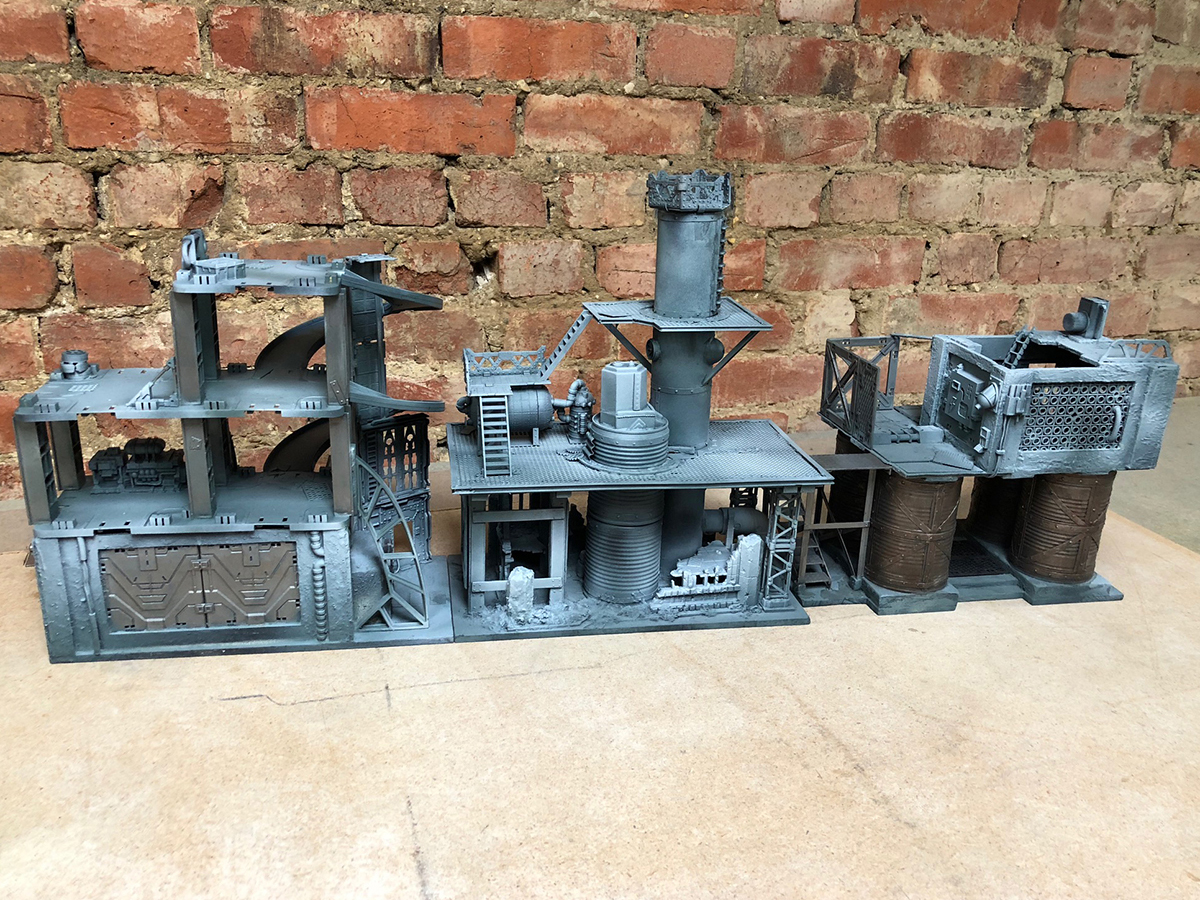
Today a quick update on my quest to put together some modular, scratch-built, sci-fi industrial terrain for my toy soldiers to fight over. The idea is to be able to use a small collection of buildings in varying configurations to represent not just different areas of my WH40K city, Kruenta Karoliina Arx Rotunda, but also different styles of board for different types of game – like a larger, clearer board for 40K and smaller, more detailed, multi-level boards for skirmish games like Necromunda and Kill Team.

I've built and undercoated three pieces so far, with each one sat on a 12" by 6" base plate. This standardised size means that in the final design the buildings will be easily interchangeable to suit the needs and aesthetic of any particular game.

In my mind the aim of a modular project like this is to create the minimum amount of pieces to give you the maximum amount of possibilities. I won't go into any more detail about this now, but will probably discuss the plans when (and if) I ever manage to build the larger floor sections.

In terms of painting, these are by no means finished yet. The roughly highlighted undercoat, along with the beginnings of some of the metallic sections are just there to unify the models and give me an idea of what they could look like.


You can see earlier, work in progress versions of two of the buildings, prior to their undercoats here and here. But the third one is new, so I've included photos of the unprimed model below.

A lot of the techniques I've used in these models, and in the modular approach itself, came from a series of brilliant scenery articles in White Dwarf, way back in 2001. For anyone interested, I've collated them all here.