Friday, 26 February 2016

The Giant Robo Alphabot, part five

It's time for two more entries in the robot alphabet. Today's pair have a distinctly retro feel, both hailing from the same decade. Actually, not just the same decade, but the same year. Each of these machines first appeared in 1957. Or rather they didn't, they were invented much later, but their backstories saw them both spring into action in an imaginary, alternative 1957.

So 1957 is clearly a good vintage for giant robotic things. But what's the significance of that year? If you're not sure then the answer can be found somewhere in the text in one of the images.


Also, as I've said before, if you're partial to a bit of Pinterest then clicking right here will allow you to see all the existing posters in one place.


Tuesday, 23 February 2016

Gunslingers, mercenaries, bodyguards, agents and adventurers

To simplify the extensive list of professions in the title, this post is basically about people who carry guns. People who carry guns and could be found within my Warhammer 40,000 (WH40K) Imperial hive city, Kruenta Karoliina Arx Rotunda.

I decided I wanted a bunch of guys who aren't Astartes, Astra Militarum or Mechanicus. Instead they're private bodyguards, mercenaries or independent Imperial agents. The kind of hard cases who would be hired by noble houses, merchant guilds, Inquisitors and Rogue Traders, to ensure that bumps get smoothed, and lumps get liquidated. The kind of characters that often crop up in Dan Abnett's excellent Inquisitor books (the Eisenhorn trilogy, the Ravenor trilogy, and, at the time of writing, the first part of the Bequin trilogy).


Some of them will be ex-Imperial Guard, some will be gangers or members of criminal cartels, while others may even have undertaken rare martial training at specialist scholams. Doubtless they are all very dangerous in a civilian context, though it's unlikely any would match up to an individual Astartes or Custodes legionary.


As with most of my scratched together conversions the basic models come from a variety of places. There are three that started life as Urban War Triad Retainers with Naginata Pole Arms (a lot of the excellent Urban War range appears to be out of print now and this is the only picture I could find of the original models), three that are basically Games Workshop kit bashes (trying to use up some of the myriad pieces left over from my 'Dredd' style Arbites project), one from Mike McVey's Sedition Wars range and a Grymn Pilot from Kev White's Hasslefree Miniatures.


All those basic miniatures suffered a bit of chopping and/or repositioning, before I got down to the fun part of the job: covering them in extra weapons, packs, armour plates, cables, heads and belts etc.


Did I have any idea what I was trying to achieve? In this case, surprisingly, yes. For a few of these characters I took my inspiration from the video game Destiny. Looking at the images on this Google search of Destiny concept art, the game is very close in tone to WH40K. Could Destiny have originally been inspired by WH40K?


If so, then in my 28mm take on these things, I suppose the circle is now complete.


Friday, 12 February 2016

Rogue inspiration

Anyone who knows me will have noticed I'm something of a fan of the comic 2000AD. That's because it's not just awesome, but also, at least partly, responsible for the fact that I'm now a grown man who writes about science fiction in his spare time.

When I was a kid one of my favourite stories was Rogue Trooper. A genetically engineered soldier bred to fight in the harsh, chemical environment of the war-torn planet Nu Earth.

I recently bought the graphic novel Jaegir. It collects a new story set in that old Rogue Trooper universe. Specifically the part of the universe occupied by the Norts. The Norts were the heavily militarised, fascistic, totalitarian bad guys of the original story. They had the best gear, legions of crack troops and a seemingly non-existent moral code. What makes Jaegir so interesting is we get to see how these guys operate away from the warzone, in their cities and homelands.

The comic is written by Gordon Rennie (who has also written a handful of novels for Games Workshop and the script for the video game Killzone) and drawn by Simon Coleby (who drew Inquisitor Ascendant for Games Workshop and whose work keeps getting better and better).

If you haven't read Jaegir yet, but were a fan of the old Rogue Trooper I can thoroughly recommend it. It's note perfect in it's depiction of the Norts behind their frontlines.


The Norts are, generally, not very nice people. But their uniforms are kinda cool. That's cool in an oppressive, authoritarian, dystopian kind of way, of course. Upon reading the comic I was struck by the similarities of Nort officers with another oppressive, authoritarian, dystopian science-fiction universe. So struck that, as a short project and a little break from my 'Dredd' style Arbites Enforcers, I was inspired to build an officer for the denizen part of my city project. I took his tunic from the guy in the top left panel of the middle image and much of the rest of the uniform from the man in the bottom right of the third image.

I figured the resulting character could easily be found among the higher echelons of Kruenta Karoliina Arx Rotunda social circles, or perhaps aiding a local Inquisitor in deciphering anomalous fleet dispositions, or just assisting the Arbites with an incident where the clues keep pointing to one of the sprawling military establishments.


For those with an interest in this kind of thing, the head is from the officer that comes with the Baneblade tank, the body and legs are from a Dark Vengeance Chaos Cultist, the bolt pistol once belonged to a Space Marine Scout, the sword probably comes from a Marine of some kind, and the arms were scratched together with whatever bits I had lying around.


Friday, 29 January 2016

Hammerstein the ABC Warrior

If you're looking for a hard-as-nails, humanoid war robot, with a grim visage and a keen sense of honour, then Hammerstein the ABC Warrior could be for you.

If you already know all about him, then, um, well, I think we should probably be friends. So, er, read on friend.

If you've never heard of him then fear not, I'm about to fill that war-robot-shaped hole in your life — mainly by showing some of the early comic strips, magazines and other media where Hammerstein first reared his metal head. Although, it's worth saying right now, it's not always the same metal head.

The robot is a creation of the legendary Pat Mills, the visionary behind 2000AD, and its original Tharg (2000AD speak for editor). Hammerstein's first ever appearance was as an army surplus robot for sale in the Ro-Busters strip, Day of the Robot in issue one of Starlord.


His first action sequence came just a few pages later in the same issue, in the North Sea Tunnel story.

Although Pat Mills credits Kevin O'Neill with co-creating Ro-Busters, Carlos Pino was the artist on the first stories

Pat Mills took Ro-Busters to 2000AD in 1978, when Starlord merged into it in Prog 86.

Art by Dave Gibbons (who later became the co-creator of Watchmen)

The ABC Warriors started in prog 119 of 2000AD, with a subhead stating it was a new Ro-Busters adventure. In this strip Hammerstein sported his older, more human-looking head.


Illustration by Kevin O'Neill, one of Pat Mills' long-term collaborators

Three episodes later and Hammerstein was off to recruit Mongrol to join his group.

Art by the much-loved Mick McMahon made the badass robot look more badass than ever

A three page prologue was published later which linked the ABC Warriors even more closely with Ro-Busters.

Kev O'Neill's signature style shines through

Hammerstein showed up in a third title when he and his robot warriors made a surprise appearance, set thousands of years after their previous adventures, in the strip Nemesis The Warlock. For a short while they were a regular fixture.


Art by the versatile Bryan Talbot (who also created, among other things, The Tale of One Bad Rat, a Beatrix Potter inspired story of abuse and homelessness, that couldn't be more removed from sci-fi war robots)

Nemesis eventually gave them a side mission and the warriors returned to their own strip in the story The Black Hole. Here we learnt that much of Hammerstein's head was actually a removable helmet, worn over the human-looking features.

And the world was introduced to the great Simon Bisley

Later in the mission we were shown more of Hammerstein's early days, including the Mark One and Mark Two war robots that predated his design. The sequence also tells how he felt his first emotion.

S.M.S. provided the intricate illustrations for this portion of the tale

The story continued directly into the first regular, full colour ABC Warriors strips Khronicles of Khaos and Hellbringer.
The art went from strength to strength when Kev Walker was brought on board

Not long after this Kev Walker and Chris Halls (who later changed his name to Chris Cunningham) designed a robot for inclusion in the Sylvester Stallone film Judge Dredd (more of that here). It looked suspiciously like Hammerstein, but was only ever referred to as an ABC War Robot. The ambiguity over the robot's identity was soon dispelled by 2000AD when Hammerstein entered his fourth different strip in the comic. He had a cameo in Judge Dredd, fighting judges in a flashback story that firmly established his presence in the film. The story is largely thought to have been ret-conned out of continuity now, which is a shame because the art alone deserves to live on for an ABC Warrior's lifespan.

Incredible art by Jason Brashill

Later on, in The Volgan War flashback story, told in ABC Warriors in 2000AD, we discovered that there were many other similar Hammerstein pattern robots, but that our Hammerstein was unique among his kind for being capable of independent thought. We also learnt that all Hammersteins were originally designed to have 4 arms.

Art by Clint Langley

The story of the early Hammerstein units was picked up in the 2000AD strip Savage, set in a contemporary Britain, occupied by hostile foreign forces. This story showed us Mark One war robots in the Hammerstein pattern. Presumably different models from the ones we had seen earlier in The Black Hole. Although not Hammerstein himself, they are still clearly Hammerstein units, so they're kind of like his granddad.

Especially if his granddad was not a very reliable person. The art by Patrick Goddard took Hammerstein back to black and white

He also appeared in Issue 2 of the short-lived Dice Man magazine. A gamebook style spin-off comic of 2000AD edited by Mills in the 80s.

And whatever happened to this short animation? It appears to be a promo for an ABC Warriors cartoon.


So, by my count Hammerstein has appeared in at least 3 different magazines, in 4 or 5 different strip titles, he's been in a major Hollywood movie (sort of), and nearly had his own cartoon.

And on top of all that there have been several commercial models made of him, including this one in a roughly 28mm scale and this larger one more suitable to 32mm, both by Wargames Foundry, and the no longer available PVC kit from Tsukuda Hobby, based on his movie appearance.

These days Hammerstein can still be seen in 2000AD, having recently returned in an all-new set of Ro-Busters stories.

As usual, if you've got anything to add, please do so in the comments below.


Thursday, 14 January 2016

So what about these dark gods then? Some chaotic ramblings on a chaotic subject

The dark fantasy game, Warhammer (WFB*) shares its most notorious bad guys, the Chaos Powers, with its science fiction counterpart, Warhammer 40,000 (WH40K). These super-villains are the horrors at the very top of the evil-doers food chain**. They're an insanely powerful set of ethereal beings, seemingly hell-bent on death and destruction, or at least resolutely driven to royally screw things up.

At first glance there appear to be four of these dark gods, but it's not quite as simple as that. We'll come back to this in a moment.

From one game to the other, there are a few subtle differences in their back stories, but all the main characteristics are pretty much identical. The similarities are so overwhelmingly strong that the Chaos Gods' presence in both games could be the main reason for all the speculation on the relationship between the WFB realm and the WH40K universe (see here for a quick round-up and here for my thoughts on the subject).

Of course, all the speculation makes it hard to prove that they're the exact same horrible bad guys. It's hard to find definitive answers. Very little light has been shone into these darkest of dark corners.

However, over the years, Games Workshop have released a few key milestones.

One such key milestone happened in the late eighties and early nineties. Back in those swirling mists of time we were given Slaves to Darkness (1988) and The Lost and the Damned (1990), collectively known as the Realm of Chaos books.


I say 'given', but actually these were really expensive

These books fleshed out pre-existing Chaos lore and added much of the additional material we are familiar with today. They contained the first list of the four Chaos Gods: the two unpronounceable ones, Slaanesh and Tzeentch; the meat-eater that sounds like a vegetarian, Khorne; and the bringer of sick days, Nurgle.

In those weighty tomes this evil pantheon was described as the ‘four major Chaos Powers’. But that word major, really implies that there might be other, minor Chaos Gods out there. So who might these missing minor gods be?

From a theoretical perspective, seeing as minor and major are comparative terms, the minor gods only need to be a bit less powerful than the major ones. And simple lexicon would surely place them above Greater Daemons. Yet Greater Daemons are no push over. Warhammer 40,000 Wiki describes these monstrous Chaos lieutenants ‘as huge, terrifying creatures capable of slaying scores of warriors and destroying even main battle tanks. They have strange, sorcerous powers drawn from the psychic energy of the Warp and are virtually impervious to mortal weapons’.

That places our minor gods somewhere between extremely dangerous and unstoppably insane. Strange then that for such a deadly foe in Games Workshop lore we have been told almost nothing about them.

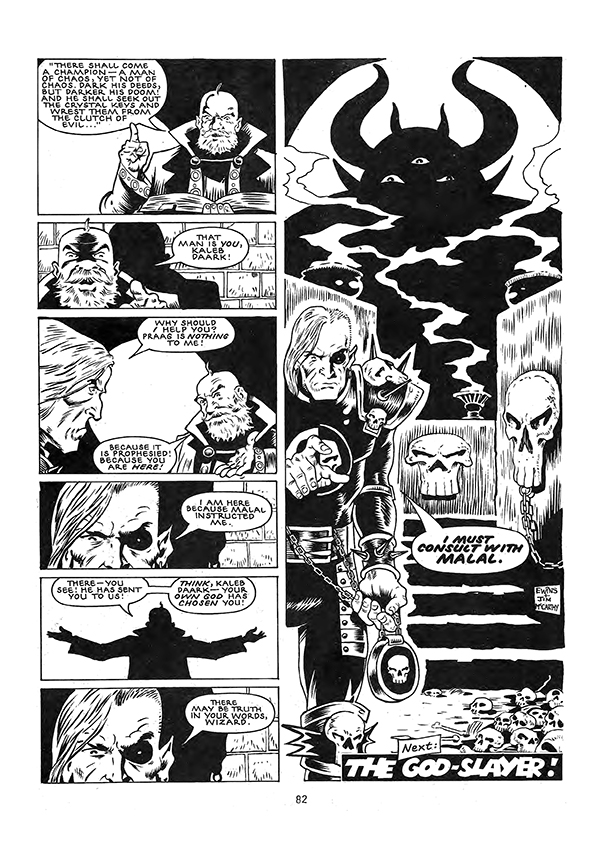
Almost nothing, but not quite. For anyone who remembers back to those darkly swirling mists of the 1980s there was once a fifth Chaos God. Whether it was a major power or a minor power was never explicitly stated, but it was certainly meant to be dangerous. If you were born in the 70s or before, and had an unhealthy interest in Citadel Miniatures, or you are just magnificently well-read, you may be familiar with Malal, the renegade God.

Malal was invented by a team lifted directly from 2000AD: John Wagner (co-creator of Judge Dredd), Alan Grant (Wagner's writing partner on Dredd for most of the eighties), the late, great Brett Ewins (who coincidentally lived around the corner from the first ever Games Workshop store near Ravenscourt Park in West London) and Jim McCarthy (Ewins' long-time art partner and brother to Brendan McCarthy of Mad Max Fury Road fame). Their dark god made his first appearance as a somewhat ambiguous antagonist in one of the earliest Games Workshop comic strips, The Quest of Kaleb Daark.


After the struggles that 2000AD creators had with IPC and the copyright to their characters, this all-star creative team was reluctant to give Games Workshop the intellectual property to Malal. So the comic was never completed and Games Workshop pretty much canned their planned expansion of Malal's presence in the game.


Any further references to him were in a new guise, that of Malice.

If you fancy some further reading there are a couple of more detailed posts about Malal, including mention of his second most infamous follower, Skrag the Slaughterer, the ogre renegade, over at Realm of Chaos 80s here and here. 

As far as I'm aware Malal only appeared in the WFB setting, but if the gods are indeed the same from WFB to WH40K then he could equally pop up in the 41st millennium at any point. Or the 31st for that matter. 


But not just Malal. If there are four major gods at the top, and countless numbers of greater daemons positioned on the third tier, then it follows that there would be a whole host of minor gods sitting in between them. Minor gods that are yet to be named, designed or explored. Minor gods that are fair game for anyone wanting to do their own thing. Minor gods that could well end up as the patron deities of your own collection of Chaos followers. 

I'll be picking up on this theme in a later post.


*Or Warhammer Age of Sigmar (AoS) if you prefer. But I'm old skool at heart, I referred to Snickers as Marathons for years. And besides, I'm not sure Slaanesh still exists in the reboot, so that would pretty much kill half this article. What's that you say? No bad thing?
**Or perhaps you think that title belongs to the Tyranids. Or maybe the C’tan. Or the Orks, or whatever the all-powerful army of the moment may happen to be. For the sake of this article let's just agree it’s the Chaos Powers. Or agree to disagree. Or you could write me a compelling argument in the comments section.


Tuesday, 5 January 2016

The Giant Robo Alphabot, part four

In my first post of 2016 it's time to atone for one of my final posts of 2015 - this one about trying to make Jar Jar Binks cool. The karma sprites need appeasing, so I'll try to do that by showing some Star Wars things that are genuinely cool. In fact the Star Wars things I want to show are, arguably, the genuinely coolest, most influential vehicles ever seen on screen. And while I'm showing cool robotic things from movies I figured this other entry, the versatile, murderous offspring of a beach ball and an iMac, from the film Oblivion, was an interesting counterpoint to the heavily mechanical transports of the Galactic Empire.


To see all the robot posters together on their Pinterest page look here, or if you'd rather just see all the relevant posts from this blog in one easy-to-find place then try a slice of this.


Wednesday, 23 December 2015

Now I have a machine gun. Ho, ho, ho.


Today we're going to start with a question. What do the above ten movies have in common?

If you want to study the picture and work it out for yourself, you ought to stop reading now.

Like, right now.

Because I'm about to give you the answer.

They are all set (or have key scenes set) during Christmas.

It's relevant, see? It's a time of year where we imagine settling down in front of a roaring fireplace with loved ones and family members to watch a tonne of films on television. But a lot of the films we end up watching are the ones being broadcast on the main TV channels - often characterised by schmaltzy, saccharine, storylines where Santa Claus is a real person and Jingle Bells plays loudly in New York department stores.

So if you're after something a little different, check out this list of movies for alternative Christmas viewing. In all of them we get to see Yuletide without the elves, without Santa Claus and without the mushiness. And in at least one of them Bruce Willis has a machine gun. Ho, ho, ho.

Ten Alternative Christmas Movies

Die Hard (1988)
This is an obvious one. It's action packed, funny, original and has Bruce Willis at his very best. A lot of people watch this film every single year. And they're unlikely to stop any time soon - because you know what they say about old habits.


Gremlins (1984)
Is this a monster flick? Kind of, but there's definitely more than one critter, and although not very big, they're mischievous, nasty, little buggers. Setting it in what appears to be a homebaked American village during the holiday season, worthy of a place in It's a Wonderful Life, just adds to the eventual chaos.


Kiss Kiss Bang Bang (2005)
Great cast, acid sharp script, brilliant characters and a beautifully twisted plot. All of which is centred around a murder at Christmas. Extra fun if you're a Raymond Chandler fan.


Batman Returns (1992)
Back before Chris Nolan rewrote the way superhero movies worked, there were a couple of excellent Batman films made by Tim Burton. The second one was set in a snowy Gotham City, offering a little extra juxtaposition for the creepy bad guys.


The City of Lost Children (1995)
Okay, so although I promised you films that don't feature Santa Claus, he's in this. And not just one. There's a whole room full of them. But being such a darkly inventive science-fiction film you never come too close to any schmaltz.


12 Monkeys (1995)
Bruce Willis again. Does he have a machine gun? You'll have to watch it to find out. But director Terry Gilliam's twisted time-travel film keeps you as confused as the protagonist, slowly revealing the plot, until an ending where you realise all the threads have come together. Look out for the Christmas moments.


Prometheus (2012)
This prequel to the Alien movies is almost entirely set at Christmas. Did you know that? Props to Pete 'The Chef' Cook for pointing it out. Apparently there's a scene where a Christmas tree makes it abundantly clear. I have no recollection whatsoever, and it's not quite good enough for me to want to watch again right now. But the visuals are utterly fabulous so I'm sure I'll get round to it soon.


I Am Legend (2007)
When a virus causes mass panic on the streets of New York City at Christmas, the resultant, mutated inhabitants look less like the vampires of the original book and more like zombies. But it's the change to the ending that really infuriated the fans. That said, it's still a pretty decent movie. Certainly more so than the earlier Charlton Heston adaptation, The Omega Man. And who doesn't love Will Smith?


First Blood (1982)
The Rambo films were pretty silly. A bare chested Sly Stallone obliterating America's enemies with a rocket launcher and a heavy machine gun probably torn from a tank. All pretty silly except the first one, where he's forced to use his black ops survival skills against good ol' yankee cops. An exciting film dealing with PTSD, the dislocation of veterans returning to society, and what it's like to sew yourself back together after a vicious fall. Look out for the decor in the Sheriff's office. It's that which tells us the film takes place at Christmas.


L.A. Confidential (1997)
In one of the opening scenes Russell Crowe's brawny, hard-as-nails detective pulls the Christmas lights off a bad guy's roof. From then on the film takes you deeper and deeper into LA's criminal underworld of the 1950s. And with Guy Pearce's scrawny smarts we are shown a shift of ideologies between the old world and the new. Based on the book by James Elroy.